Office Ergonomics and Cervical Alignment for Desk Workers
Last updated: October 2026
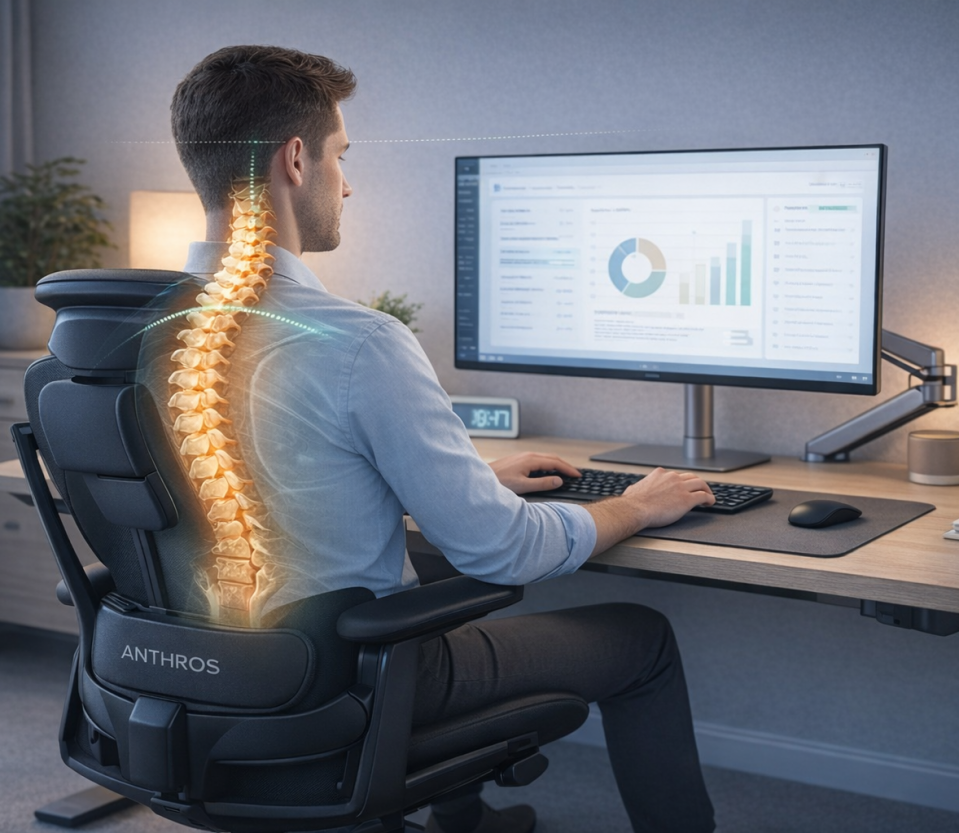
Office ergonomics affects cervical alignment because the neck holds whatever position the workstation puts it in, for hours at a time. Sleep decides whether that tissue recovers or carries the load into the next day. Pillow height changes cervical alignment and neck muscle activity measurably (Kim et al., 2015; Jiao et al., 2025), which makes the pillow the part of a desk worker's setup that almost never gets examined.
Key takeaways
- In a radiographic study of 16 adults, pillow height changed T1 slope, C2-7 Cobb angle and neck tilt, with 10 cm most suitable in that group (Kim et al., 2015).
- In a pilot EMG study of 15 adults, the height matched to shoulder width produced the lowest neck and shoulder muscle activity (Jiao et al., 2025).
- A Pillowise fitting takes three measurements (shoulder width, neck circumference and neck length) and adds sleeping position and bed type to choose from seven sizes.
Why does desk work strain the neck?
Long sitting periods reduce movement variability and increase sustained muscle activity. When the shoulders round forward and the head moves in front of the body, the neck muscles work harder to hold the head up.
Office workers report neck pain at high rates, and workstation setup is among the factors linked to it (Cagnie et al., 2007). Office workers with neck pain also show different neck and shoulder muscle recruitment patterns during keyboard work than workers without pain, including higher sustained activity and less complete muscle rest (Szeto et al., 2005).
Common causes of desk-related cervical strain
- A monitor that is too low or too far away.
- A chair without proper back and arm support.
- Reaching for the keyboard or mouse instead of staying centered.
- Staying in one position too long without movement breaks.
What does good office ergonomics look like?
The monitor sits at or slightly below eye level. The chair supports the natural curves of the spine. The shoulders stay relaxed rather than elevated. Arm support matters too, because unsupported arms increase load on the neck and upper trapezius.
Movement breaks are the other half. A few short breaks each hour, with gentle mobility work, vary the load rather than letting it accumulate in one position.
What does sleep do to the same tissue?
Many desk workers feel better through the day and wake up stiff. Sleep is a long static posture, roughly a third of every day, and the pillow sets the angle the neck holds through all of it.
Pillow height changes that angle measurably. A radiographic study of 16 adults found that as pillow height increased, T1 slope and C2-7 Cobb angle increased while neck tilt decreased, and identified 10 cm as most suitable for normal cervical lordosis in that group (Kim et al., 2015). A crossover study of 10 adults using finite element modeling quantified how pillow elevation shifts cranio-cervical pressure distribution across the head and neck (Ren et al., 2016).
Muscle activity follows height. In a pilot study of 15 adults using surface EMG, a pillow height matched to shoulder width produced the lowest activity in the sternocleidomastoid and trapezius during side sleeping, and was rated most comfortable (Jiao et al., 2025). A desk worker already in forward head posture for eight hours spends another eight in whatever position the pillow allows.
Why do generic pillows miss?
A standard contoured pillow, not fitted to the individual, performed no better than ordinary shapes in a randomized study of 106 side sleepers (Gordon et al., 2009). No single optimal pillow height can be specified, because it depends on four variables that differ from person to person: cervical alignment, body dimension, contact pressure, and muscle activity (Lei et al., 2021).
Read more: Why pillow fit matters more than shape
Related: Chiropractic and PT Strategies for Morning Stiffness, and Where the Pillow Fits
What we measure
Pillowise is a fitted cervical pillow that licensed healthcare providers measure and dispense, made in seven sizes.
Our sleep specialists take three measurements: shoulder width, neck circumference, and neck length. Combined with sleeping position and bed type, an algorithm identifies the best-fitting pillow from seven sizes.
The size is chosen from those three measurements plus sleeping position and bed type, rather than from a single stock height.
Shoulder width is the measurement the EMG study found mattered most. A height matched to it produced the lowest neck and shoulder muscle activity during side sleeping (Jiao et al., 2025), and body dimension is what drives the individual optimum (Tian et al., 2025).
A systematic review of 11 studies covering 309 participants identified a 7 to 11 cm unloaded central height among the parameters supporting spinal alignment and sleep comfort (Radwan et al., 2021). A meta-analysis covering nine studies and 555 participants found pillow use improved waking pain and neck disability, and satisfaction with the pillow increasing (Pang et al., 2021).
Pillowise pillows are made from premium Dutch memory foam and certified to OEKO-TEX Standard 100, meaning every component has been tested against the standard's limits for harmful substances.
Scope
The clinical trial literature is small. Individual studies run from 15 to 106 participants, and the most recent systematic review found no clear advantage for any single pillow type in chronic neck pain (Ghosh et al., 2025). The alignment and muscle-activity findings are consistent and directly measured. We position a fitted pillow as an adjunct to ergonomic and clinical care rather than as a treatment for a condition.
Provider takeaways
When evaluating a desk worker with neck pain, ask about the workstation and the pillow. Many patients are surprised to learn that the pillow they use for eight hours holds the same forward head posture they are trying to correct at the desk.
A fitted pillow extends the work of the visit into the hours between visits, alongside the exercise, manual therapy, and other care the provider is already delivering. Practices dispense it as part of the same plan.
Common questions
Why does my neck hurt more after a day at my desk?
Sitting at a desk holds the neck in one position for hours, and the head often drifts forward of the shoulders. Office workers with neck pain show different neck and shoulder muscle recruitment patterns during keyboard work than workers without pain, including higher sustained activity and less complete muscle rest (Szeto et al., 2005). Workstation setup is among the factors linked to neck pain in office workers (Cagnie et al., 2007).
Does my pillow matter if my desk setup is already good?
Sleep is about a third of the day, and it is the part where the neck holds one position longest. Pillow height changes cervical alignment and pressure distribution across the head and neck measurably (Kim et al., 2015; Ren et al., 2016), and a height matched to shoulder width produced the lowest neck muscle activity in a pilot EMG study (Jiao et al., 2025). A good desk setup addresses the waking hours only.
Is a contoured pillow from a store enough?
Not reliably. A standard contoured pillow, not fitted to the individual, performed no better than ordinary shapes in a randomized study of 106 side sleepers (Gordon et al., 2009), and no single optimal height can be specified because it depends on four variables that differ from person to person (Lei et al., 2021). A contour helps only if its height matches the person using it. That is what the fitting settles, in a provider's office.
Find a Pillowise provider or become one
Pillowise pillows are clinically measured and dispensed exclusively through licensed healthcare providers as part of broader sleep, posture, and recovery education.
To locate a Pillowise provider near you, visit: Find a Reseller
Licensed healthcare providers interested in offering Pillowise may register here: Become a Reseller
References
Cagnie, B., Danneels, L., Van Tiggelen, D., De Loose, V., & Cambier, D. (2007). Individual and work related risk factors for neck pain among office workers: A cross sectional study. European Spine Journal, 16(5), 679-686. https://doi.org/10.1007/s00586-006-0269-7
Ghosh, S. K., Goyal, M., & Goyal, K. S. (2025). Effect of pillow on pain, disability and sleep quality in patients with chronic neck pain: A systematic review. Rehabilitación, 59(3), 100922. https://doi.org/10.1016/j.rh.2025.100922
Gordon, S. J., Grimmer-Somers, K., & Trott, P. (2009). Pillow use: The behaviour of cervical pain, sleep quality and pillow comfort in side sleepers. Manual Therapy, 14(6), 671-678. https://doi.org/10.1016/j.math.2009.02.006
Jiao, R., Xiao, W., Wang, M., Yu, S., & Li, H. (2025). The impact of pillow height on neck muscle activity: A pilot study. Sleep and Breathing, 29(1), 40. https://doi.org/10.1007/s11325-024-03219-6
Kim, H. C., Jun, H. S., Kim, J. H., Ahn, J. H., Chang, I. B., Song, J. H., & Oh, J. K. (2015). The effect of different pillow heights on the parameters of cervicothoracic spine segments. Korean Journal of Spine, 12(3), 135-138. https://doi.org/10.14245/kjs.2015.12.3.135
Lei, J.-X., Yang, P.-F., Yang, A.-L., Gong, Y.-F., Shang, P., & Yuan, X.-C. (2021). Ergonomic consideration in pillow height determinants and evaluation. Healthcare, 9(10), 1333. https://doi.org/10.3390/healthcare9101333
Pang, J. C.-Y., Tsang, S. M.-H., & Fu, A. C.-L. (2021). The effects of pillow designs on neck pain, waking symptoms, neck disability, sleep quality and spinal alignment in adults: A systematic review and meta-analysis. Clinical Biomechanics, 85, 105353. https://doi.org/10.1016/j.clinbiomech.2021.105353
Radwan, A., Ashton, N., Gates, T., Kilmer, A., & VanFleet, M. (2021). Effect of different pillow designs on promoting sleep comfort, quality, & spinal alignment: A systematic review. European Journal of Integrative Medicine, 42, 101269. https://doi.org/10.1016/j.eujim.2020.101269
Ren, S., Wong, D. W.-C., Yang, H., Zhou, Y., Lin, J., & Zhang, M. (2016). Effect of pillow height on the biomechanics of the head-neck complex: Investigation of the cranio-cervical pressure and cervical spine alignment. PeerJ, 4, e2397. https://doi.org/10.7717/peerj.2397
Szeto, G. P., Straker, L. M., & O'Sullivan, P. B. (2005). A comparison of symptomatic and asymptomatic office workers performing monotonous keyboard work 1: Neck and shoulder muscle recruitment patterns. Manual Therapy, 10(4), 270-280. https://doi.org/10.1016/j.math.2005.01.004
Tian, S., Yao, C., Wang, Y., Cao, X., Sun, Y., Wang, L., & Fan, Y. (2025). The individualized optimal pillow height and neck support design for side sleepers. Medical and Biological Engineering and Computing, 63(2), 535-544. https://doi.org/10.1007/s11517-024-03204-x
- Pillowise USA
- 615 W Johnson Ave, Suite 104
- Cheshire, CT 06410
- (844) 291 7392
- info@pillowise-usa.com
- Send us a message on WhatsApp