

Is Forward Head Posture Linked to Neck Pain?
Last updated: November 2026
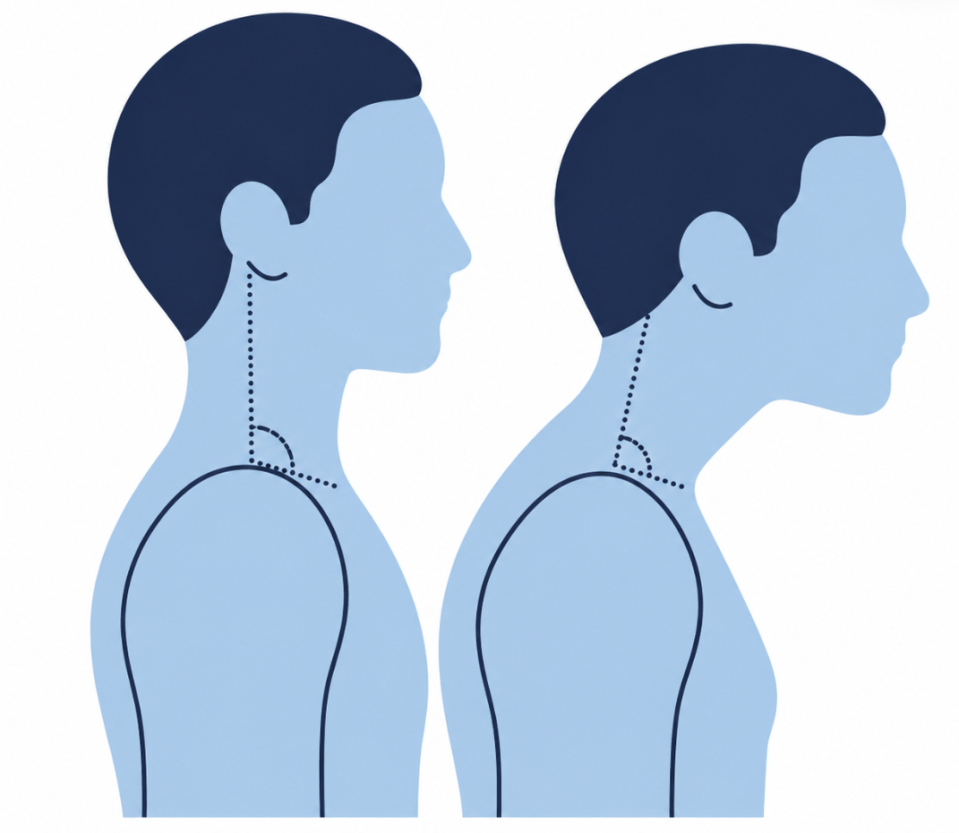
Forward head posture is linked to neck pain: across 15 cross-sectional studies, adults with neck pain carried their heads further forward than adults without it, and the further forward the head sat, the higher their pain and disability scores (Mahmoud et al., 2019). The studies show an association, not proof that posture causes the pain. This article covers what the posture research shows, then what pillow height measurably changes at night and how a Pillowise fitting chooses it.
Key takeaways
- Across 15 cross-sectional studies, adults with neck pain had more forward head posture, which correlated with pain (r = -0.55) and disability (r = -0.42) (Mahmoud et al., 2019).
- In 34 adults lying on their side, those with forward head posture showed more middle and lower trapezius activity on all three pillows tested (Kiatkulanusorn et al., 2021).
- Pillowise is chosen from three measurements, shoulder width, neck height and neck circumference, plus sleeping position and mattress firmness.
How strong is the link between head posture and neck pain?
Neck pain is common and growing. An estimated 203 million people worldwide lived with neck pain in 2020, and the Global Burden of Disease team projects 269 million by 2050, driven by population growth and aging (GBD 2021 Neck Pain Collaborators, 2024).
Forward head posture is usually measured as the craniovertebral angle, taken from a side view of the head and neck. A smaller angle means the head sits further forward. In patients with neck pain, a smaller craniovertebral angle went with greater disability (Yip et al., 2008).
A meta-analysis pooled 15 cross-sectional studies. Adults with neck pain had more forward head posture than adults without symptoms, and in adults and older adults the angle correlated with pain intensity (r = -0.55) and disability (r = -0.42). In adolescents, the link did not appear (Mahmoud et al., 2019).
Do phones play a part?
Phone use tips the head down. In 18 participants, head flexion while using a smartphone ranged from 33 to 45 degrees, and texting while sitting produced the most (Lee et al., 2015).
A 2025 meta-analysis of 7 studies covering 10,715 adults found that smartphone overuse was associated with neck pain (OR 2.34). Every included study was cross-sectional, so the result is an association, not a cause (Chen et al., 2025).
Can exercise change forward head posture?
Exercise has direct evidence here. A meta-analysis of 7 randomized trials with 627 participants found that therapeutic exercise improved the craniovertebral angle and reduced pain in people with forward head posture (Sheikhhoseini et al., 2018).
That work happens in the clinic and in the home program your provider designs. Related: Office Ergonomics and Cervical Alignment for Desk Workers
What happens at night with forward head posture?
One lab study looked at this directly. Researchers compared 17 adults with forward head posture and 17 with normal head posture lying on their side on three pillow designs, using surface EMG (Kiatkulanusorn et al., 2021).
The forward head posture group showed more middle and lower trapezius activity on all three pillows. Upper trapezius activity changed with pillow design, and only in the forward head posture group (Kiatkulanusorn et al., 2021). The study was small, ran in a lab, and measured muscle activity, not pain.
What does pillow height measurably change?
On your back, height changes the curve of the neck. In 16 adults without symptoms tested at 0, 10 and 20 cm, T1 slope and the C2 to C7 Cobb angle increased as the pillow rose while neck tilt decreased, and 10 cm suited normal lordosis best (Kim et al., 2015).
Height also changes where pressure lands. A finite element study of 10 healthy participants lying on their backs, at heights from 110 to 170 mm, showed pressure under the head and neck shifting with each change in height (Ren et al., 2016).
On your side, height changes muscle activity. In a pilot study of 15 adults, a height equal to shoulder width produced lower sternocleidomastoid and trapezius activity, and higher comfort, than heights at half or one and a half times shoulder width (Jiao et al., 2025).
Why do generic pillows miss?
A standard contoured pillow, not fitted to the individual, performed no better than ordinary shapes in a randomized study of 106 side sleepers (Gordon et al., 2009). No single optimal pillow height can be specified, because it depends on four variables that differ from person to person: cervical alignment, body dimension, contact pressure, and muscle activity (Lei et al., 2021).
Read more: Why pillow fit matters more than shape
What we measure
Pillowise is a fitted cervical pillow that licensed healthcare providers measure and dispense.
A licensed healthcare provider or Pillowise partner takes three measurements: shoulder width, neck height, and neck circumference. Combined with sleeping position and mattress firmness, an algorithm identifies the best-fitting pillow.
Shoulder width is the measurement the EMG study found mattered most. A height matched to it produced the lowest neck and shoulder muscle activity during side sleeping (Jiao et al., 2025), and body dimension is what drives the individual optimum (Tian et al., 2025).
The size is chosen from those three measurements plus sleeping position and mattress firmness, rather than from a single stock height. Pillowise pillows are made from premium Dutch memory foam, OEKO-TEX Standard 100 certified, with a uniform cervical height.
Scope of the evidence
The posture studies are cross-sectional, and the pillow studies measured alignment, pressure and muscle activity in small lab groups with no pain outcome. Reviews of pillow clinical outcomes are mixed: the most recent screened 29,091 records, included five studies covering 239 patients, and found no clear advantage for any pillow type (Ghosh et al., 2025). No study has tested whether a pillow changes forward head posture, no study has tested a Pillowise pillow, and we make no such claim.
For providers
Forward head posture work and pillow fit answer different questions. Exercise and manual care address posture and pain in session and at home, and the fitting settles the height the neck rests at overnight.
A fitted pillow extends the work of the visit into the hours between visits, alongside the exercise, manual therapy, and other care you are already delivering. Patients who ask about "tech neck" are already thinking about posture, which makes the fitting an easy next conversation.
Staff training runs 15 to 30 minutes by Teams or Zoom, any trained staff member can take the measurements, and returns and exchanges are handled by Pillowise directly. More than 5,000 healthcare professionals worldwide trust and recommend Pillowise.
Common questions
Can a pillow correct forward head posture?
No study has tested that, and we make no such claim. The posture evidence is for exercise, which improved the craniovertebral angle in 7 randomized trials (Sheikhhoseini et al., 2018). A fitted pillow is a separate question: it sets the height your neck rests at during sleep.
Is phone posture the same as forward head posture?
The studies measure different things. Phone research usually measures head flexion, the head tipped down during use (Lee et al., 2015), while forward head posture research usually measures the craniovertebral angle (Mahmoud et al., 2019).
Does the link show up in teenagers?
Not in the pooled data. The meta-analysis found the posture and pain link in adults and older adults, with no association in adolescents (Mahmoud et al., 2019).
Is a contoured pillow from a store enough?
Not reliably. A standard contoured pillow, not fitted to the individual, performed no better than ordinary shapes in a randomized study of 106 side sleepers (Gordon et al., 2009), and no single optimal height can be specified because it depends on four variables that differ from person to person (Lei et al., 2021). A contour helps only if its height matches the person using it. That is what the fitting settles, in a provider's office.
Find a Pillowise provider or become one
Pillowise pillows are clinically measured and dispensed exclusively through licensed healthcare providers as part of broader sleep, posture, and recovery education.
To locate a Pillowise provider near you, visit: Find a Reseller
Licensed healthcare providers interested in offering Pillowise may register here: Become a Reseller
References
Chen, Y.-J., Hu, C.-Y., Wu, W.-T., Lee, R.-P., Peng, C.-H., Yao, T.-K., Chang, C.-M., Chen, H.-W., & Yeh, K.-T. (2025). Association of smartphone overuse and neck pain: A systematic review and meta-analysis. Postgraduate Medical Journal, 101(1197), 620-626. https://doi.org/10.1093/postmj/qgae200
GBD 2021 Neck Pain Collaborators. (2024). Global, regional, and national burden of neck pain, 1990-2020, and projections to 2050: A systematic analysis of the Global Burden of Disease Study 2021. The Lancet Rheumatology, 6(3), e142-e155. https://doi.org/10.1016/S2665-9913(23)00321-1
Ghosh, S. K., Goyal, M., & Goyal, K. S. (2025). Effect of pillow on pain, disability and sleep quality in patients with chronic neck pain: A systematic review. Rehabilitación, 59(3), 100922. https://doi.org/10.1016/j.rh.2025.100922
Gordon, S. J., Grimmer-Somers, K., & Trott, P. (2009). Pillow use: The behaviour of cervical pain, sleep quality and pillow comfort in side sleepers. Manual Therapy, 14(6), 671-678. https://doi.org/10.1016/j.math.2009.02.006
Jiao, R., Xiao, W., Wang, M., Yu, S., & Li, H. (2025). The impact of pillow height on neck muscle activity: A pilot study. Sleep and Breathing, 29(1), 40. https://doi.org/10.1007/s11325-024-03219-6
Kiatkulanusorn, S., Suato, B. P., & Werasirirat, P. (2021). Analysis of neck and back muscle activity during the application of various pillow designs in patients with forward head posture. Journal of Back and Musculoskeletal Rehabilitation, 34(3), 431-439. https://doi.org/10.3233/BMR-200038
Kim, H. C., Jun, H. S., Kim, J. H., Ahn, J. H., Chang, I. B., Song, J. H., & Oh, J. K. (2015). The effect of different pillow heights on the parameters of cervicothoracic spine segments. Korean Journal of Spine, 12(3), 135-138. https://doi.org/10.14245/kjs.2015.12.3.135
Lee, S., Kang, H., & Shin, G. (2015). Head flexion angle while using a smartphone. Ergonomics, 58(2), 220-226. https://doi.org/10.1080/00140139.2014.967311
Lei, J.-X., Yang, P.-F., Yang, A.-L., Gong, Y.-F., Shang, P., & Yuan, X.-C. (2021). Ergonomic consideration in pillow height determinants and evaluation. Healthcare, 9(10), 1333. https://doi.org/10.3390/healthcare9101333
Mahmoud, N. F., Hassan, K. A., Abdelmajeed, S. F., Moustafa, I. M., & Silva, A. G. (2019). The relationship between forward head posture and neck pain: A systematic review and meta-analysis. Current Reviews in Musculoskeletal Medicine, 12(4), 562-577. https://doi.org/10.1007/s12178-019-09594-y
Ren, S., Wong, D. W.-C., Yang, H., Zhou, Y., Lin, J., & Zhang, M. (2016). Effect of pillow height on the biomechanics of the head-neck complex: Investigation of the cranio-cervical pressure and cervical spine alignment. PeerJ, 4, e2397. https://doi.org/10.7717/peerj.2397
Sheikhhoseini, R., Shahrbanian, S., Sayyadi, P., & O'Sullivan, K. (2018). Effectiveness of therapeutic exercise on forward head posture: A systematic review and meta-analysis. Journal of Manipulative and Physiological Therapeutics, 41(6), 530-539. https://doi.org/10.1016/j.jmpt.2018.02.002
Tian, S., Yao, C., Wang, Y., Cao, X., Sun, Y., Wang, L., & Fan, Y. (2025). The individualized optimal pillow height and neck support design for side sleepers. Medical and Biological Engineering and Computing, 63(2), 535-544. https://doi.org/10.1007/s11517-024-03204-x
Yip, C. H. T., Chiu, T. T. W., & Poon, A. T. K. (2008). The relationship between head posture and severity and disability of patients with neck pain. Manual Therapy, 13(2), 148-154. https://doi.org/10.1016/j.math.2006.11.002

- Pillowise USA
- 615 W Johnson Ave, Suite 104
- Cheshire, CT 06410
- (844) 291 7392
- info@pillowise-usa.com
- Send us a message on WhatsApp