

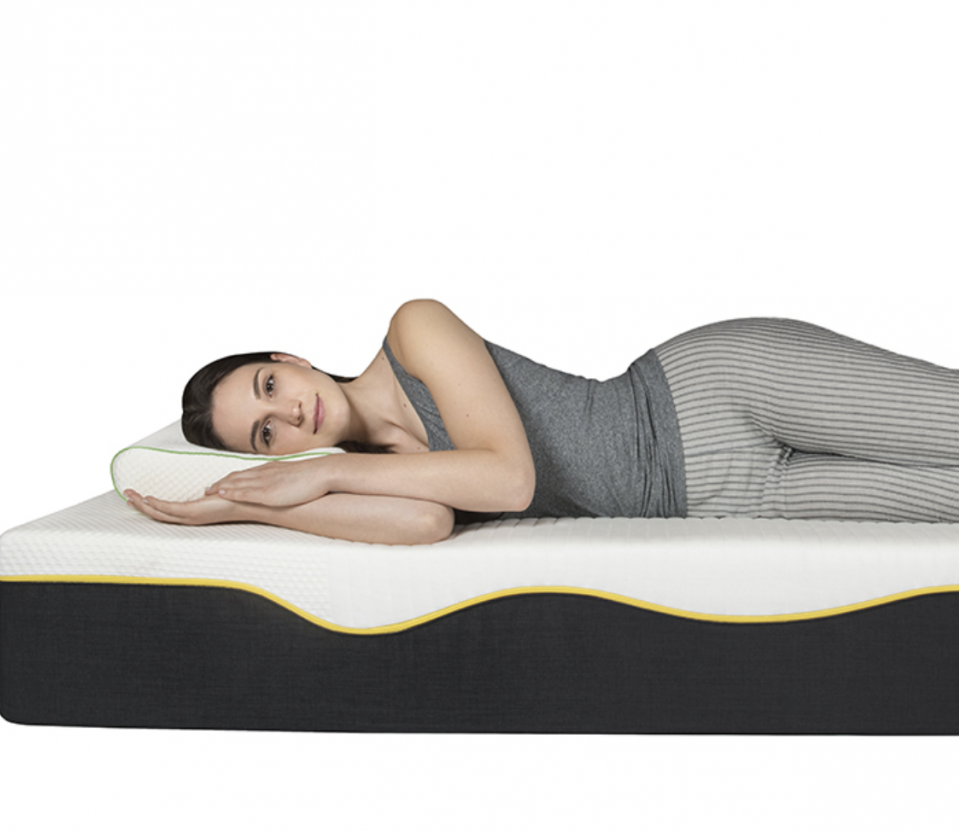
How to Choose a Pillow: Sleep Position, Mattress and Fit
Choose a pillow by height, not by fill or label: it should fill the gap between your head and the mattress so your neck stays in line with your spine in the position you fall asleep in. That gap differs between side and back sleeping and depends on your shoulders, your neck and your mattress, so no single height fits everyone (Lei et al., 2021).
Key takeaways
- Optimal pillow height differs between lying on the back and lying on the side, and no single optimal height can be specified for everyone (Lei et al., 2021).
- In a pilot study of 15 adults, a height matched to shoulder width produced the lowest neck and shoulder muscle activity during side sleeping (Jiao et al., 2025).
- A Pillowise fitting takes three measurements (shoulder width, neck height, neck circumference) and combines them with sleeping position and mattress firmness. The measurement is free at every provider.
Why is choosing a pillow in a store so hard?
Most people choose a pillow by pressing a hand into it. That tests softness. Height is the variable the research measures, and it is hard to judge by hand.
A systematic review of 11 studies covering 309 participants identified an unloaded central height of 7 to 11 cm (about 2.8 to 4.3 in) among the parameters supporting spinal alignment and sleep comfort (Radwan et al., 2021). That is a range, not a number. Where you fall within it depends on your body.
What does a shelf label tell you, and what does a fitting measure?
Store labels describe the pillow. A fitting describes you.
| On the shelf | What it tells you | What a fitting uses instead |
|---|---|---|
| Standard, queen, king | The size of the pillowcase. Nothing about height. | One of 7 sizes, chosen from your measurements. |
| Soft, medium or firm fill | How the pillow feels under your hand. | Shoulder width, neck height and neck circumference. |
| “For side sleepers” or “for back sleepers” | A position, but not your body. | Your position, plus your mattress firmness and the three measurements. |
| Contour shape | A standard shape. In a randomized study of 106 side sleepers, a standard contoured pillow performed no better than ordinary shapes (Gordon et al., 2009). | A size matched to the individual. |
How does your sleep position change the pillow you need?
Each position asks the pillow to do a different job.
| Position | What the pillow has to do | What the research shows |
|---|---|---|
| Side sleeper | Fill the space between the shoulder and the side of the head, so the neck does not drop toward the mattress. | A height matched to shoulder width produced the lowest neck and shoulder muscle activity in 15 adults (Jiao et al., 2025). |
| Back sleeper | Support the natural curve of the neck without pushing the head forward. | In 10 adults, pillow elevation changed pressure under the head and neck and cervical alignment across heights of about 4.3 to 6.7 in (110 to 170 mm) (Ren et al., 2016). |
| Stomach sleeper | Work with a head that is turned to one side for hours. | We found no study in our references that gives a height for stomach sleeping. Tell your provider this is how you fall asleep, because position is one of the fitting inputs. |
Many people change position during the night. Choose by the position you fall asleep in. If you have no idea, the fitting uses side.
For the shoulder-width detail, read side sleeping, shoulder width and pillow height.
How does mattress firmness change the choice?
Your head, shoulder and hips settle into the bed, and how far they settle changes the distance the pillow has to bridge. A pillow that fits on one bed can sit too high or too low on another.
- Soft, medium or firm: these are the three firmness options in a Pillowise fitting.
- Not sure: choose medium. That also applies to memory foam and hybrid mattresses, and to hotel beds.
- Heavier body: weight is not part of the algorithm. A heavier person sinks deeper and may need a lower pillow, so the provider checks how you lie on it and adjusts if needed.
If you change mattresses, tell your provider. The same body measurements with a different firmness can point to a different size.
Why does the best height follow the person?
Body dimensions drive the individual optimum. In a laboratory study of 9 side sleepers tested at 8, 10, 12 and 14 cm (about 3.1 to 5.5 in), the best height followed the person (Tian et al., 2025). Two people in the same position can still need different pillows.
To see how a fitted pillow is matched to your measurements, read why a fitted pillow is sized to the body instead of the shelf.
How do you choose a pillow, step by step?
- Name your position. Note the position you fall asleep in: side, back or stomach.
- Name your mattress. Note whether it is soft, medium or firm. If you are unsure, say medium.
- Get measured. Shoulder width, neck circumference and neck height are measured, ideally by a second person. You can try the manual measurement on Find Your Pillow Size, or have a provider do it.
- Give it time at home. Allow 7 to 10 days to adjust. The 30-day comfort guarantee lets you exchange for another size or return the pillow for a refund within 30 days of purchase. Return shipping is paid by the customer.
Not sure what step 3 involves? What happens in a pillow fitting walks through it. If your current pillow already feels off, see how to tell if your pillow is the wrong height. For habits that help whichever pillow you use, see tips for a better sleep.
How does Pillowise approach it?
Pillowise is a fitted cervical pillow, sold only through licensed healthcare providers: chiropractors, physical therapists and licensed massage therapists. It is not sold in retail stores. The provider takes the three measurements. The Pillowise algorithm combines them with your sleeping position and mattress firmness and picks one of 7 sizes. The system indicates the right size for about 95% of people, and the provider checks the position on the pillow and adjusts if needed, for example in pregnancy.
The standard pillow measures 22 x 14 in. The core is 100% premium Dutch memory foam, non-toxic and latex-free, made in the Netherlands. The cover is removable and machine washable at 104°F (40°C). See the Pillowise pillows, or read why pillow fit matters more than shape.
What does the research not show yet?
The height studies above are small, from 9 to 106 participants, and most measured healthy adults rather than people with neck pain. The most recent systematic review screened 29,091 records, included five studies covering 239 patients, and found no clear advantage for any pillow type in chronic neck pain (Ghosh et al., 2025). We position a fitted pillow as an adjunct to care, not a treatment. If you have ongoing neck pain, numbness or weakness, see your own provider. More on the evidence: adjusting pillow height for neck pain: clinical studies.
Common questions
What pillow height is right for a side sleeper?
There is no single number. A height matched to shoulder width gave the lowest neck and shoulder muscle activity and the highest comfort rating in a pilot study of 15 adults (Jiao et al., 2025). The height follows the person (Tian et al., 2025).
Does adjusting pillow height make a difference people notice?
In an uncontrolled before-and-after study of 84 people with stiff shoulders and neck pain, half reached a clinically meaningful improvement in neck pain after their pillow height was adjusted (Yamada et al., 2023). A meta-analysis of nine studies and 555 participants found pillow use improved waking pain and neck disability (Pang et al., 2021). Neither design proves the pillow was the cause.
Should I be measured again if I change beds?
Tell your provider. Mattress firmness is one of the fitting inputs, and the fitting can be run again with the new bed. See the FAQ for exchanges, or ask your plan administrator whether FSA or HSA funds can be used.
Find a provider near you
Pillowise is measured and dispensed by licensed providers. The measurement is free at every reseller. Find a provider near you and book your free measurement.
Providers: to offer fitted pillows in your practice, see Pillows for Chiropractors, PTs and LMTs.
Thijs van der Hilst, physiotherapist
Co-founder of Pillowise
Last updated: October 2026
References
Ghosh, S. K., Goyal, M., & Goyal, K. S. (2025). Effect of pillow on pain, disability and sleep quality in patients with chronic neck pain: A systematic review. Rehabilitación, 59(3), 100922. https://doi.org/10.1016/j.rh.2025.100922
Gordon, S. J., Grimmer-Somers, K., & Trott, P. (2009). Pillow use: The behaviour of cervical pain, sleep quality and pillow comfort in side sleepers. Manual Therapy, 14(6), 671-678. https://doi.org/10.1016/j.math.2009.02.006
Jiao, R., Xiao, W., Wang, M., Yu, S., & Li, H. (2025). The impact of pillow height on neck muscle activity: A pilot study. Sleep and Breathing, 29(1), 40. https://doi.org/10.1007/s11325-024-03219-6
Lei, J.-X., Yang, P.-F., Yang, A.-L., Gong, Y.-F., Shang, P., & Yuan, X.-C. (2021). Ergonomic consideration in pillow height determinants and evaluation. Healthcare, 9(10), 1333. https://doi.org/10.3390/healthcare9101333
Pang, J. C.-Y., Tsang, S. M.-H., & Fu, A. C.-L. (2021). The effects of pillow designs on neck pain, waking symptoms, neck disability, sleep quality and spinal alignment in adults: A systematic review and meta-analysis. Clinical Biomechanics, 85, 105353. https://doi.org/10.1016/j.clinbiomech.2021.105353
Radwan, A., Ashton, N., Gates, T., Kilmer, A., & VanFleet, M. (2021). Effect of different pillow designs on promoting sleep comfort, quality, & spinal alignment: A systematic review. European Journal of Integrative Medicine, 42, 101269. https://doi.org/10.1016/j.eujim.2020.101269
Ren, S., Wong, D. W.-C., Yang, H., Zhou, Y., Lin, J., & Zhang, M. (2016). Effect of pillow height on the biomechanics of the head-neck complex: Investigation of the cranio-cervical pressure and cervical spine alignment. PeerJ, 4, e2397. https://doi.org/10.7717/peerj.2397
Tian, S., Yao, C., Wang, Y., Cao, X., Sun, Y., Wang, L., & Fan, Y. (2025). The individualized optimal pillow height and neck support design for side sleepers. Medical and Biological Engineering and Computing, 63(2), 535-544. https://doi.org/10.1007/s11517-024-03204-x
Yamada, S., Hoshi, T., Toda, M., Tsuge, T., Matsudaira, K., & Oka, H. (2023). Changes in neck pain and somatic symptoms before and after the adjustment of the pillow height. Journal of Physical Therapy Science, 35(2), 106-113. https://doi.org/10.1589/jpts.35.106

- Pillowise USA
- 615 W Johnson Ave, Suite 104
- Cheshire, CT 06410
- (844) 291 7392
- info@pillowise-usa.com
- Send us a message on WhatsApp