Stress and Cervical Tension: Where Sleep Alignment Fits
Last updated: October 2026
Sleep alignment fits into the stress and neck tension picture as the nighttime piece: in 3,593 hospital workers, high stress and high musculoskeletal pain were each linked to a higher risk of poor sleep (Vinstrup et al., 2018), and pillow height measurably changes neck and shoulder muscle activity in bed (Jiao et al., 2025). Daytime muscle load, short sleep and neck support are three separate threads in the research. The second half of this article covers how a measured fitting addresses the third.
Key takeaways
- In 3,593 hospital workers, high stress raised the risk ratio for poor sleep to 1.87 and a high pain score raised it to 1.48 (Vinstrup et al., 2018).
- In 15 adults lying on their side, the pillow height matching shoulder width produced the lowest sternocleidomastoid and trapezius activity and the highest comfort rating (Jiao et al., 2025).
- A Pillowise fitting combines three measurements (shoulder width, neck circumference, neck length) with sleeping position and bed type to identify the best-fitting pillow from seven sizes.
How are stress, neck tension and sleep connected?
McEwen and Akil describe the stress response as adaptive in the short term, with sustained demands adding a cumulative physiological cost they call allostatic load (McEwen & Akil, 2020). The brain is the central organ in that model, appraising threat and directing the response.
In a cross-sectional study of 3,593 Danish hospital workers, 57 percent reported poor sleep. High stress raised the risk ratio for poor sleep to 1.87, and a high pain score raised it to 1.48 (Vinstrup et al., 2018).
Stress and pain sit on the same side of that model: both were exposures, and sleep was the outcome. A patient carrying both comes to bed with two separate pressures on the same night.
What happens in the neck and shoulder muscles during the day?
Office workers with neck pain recruit their neck and shoulder muscles differently during keyboard work than workers without pain. They show higher sustained activity and less complete muscle rest during monotonous typing (Szeto et al., 2005).
That study compared symptomatic and asymptomatic workers rather than measuring stress directly. In the workers with pain, the neck and shoulder muscles rested less completely during a long, repetitive task.
Where does short sleep come in?
In 1,602 female nurses in Taiwan, 33.9 percent reported chronic neck discomfort and 34.7 percent chronic shoulder discomfort. Sleeping under 7 hours was the leading modifiable risk factor, with population attributable fractions of 8.8 and 8.6 percent (Chin et al., 2021).
The design was cross-sectional and the sample was female nurses only. Within those limits, short sleep and neck and shoulder discomfort appeared together often enough to make sleep a routine question in the history.
What does pillow height measurably change?
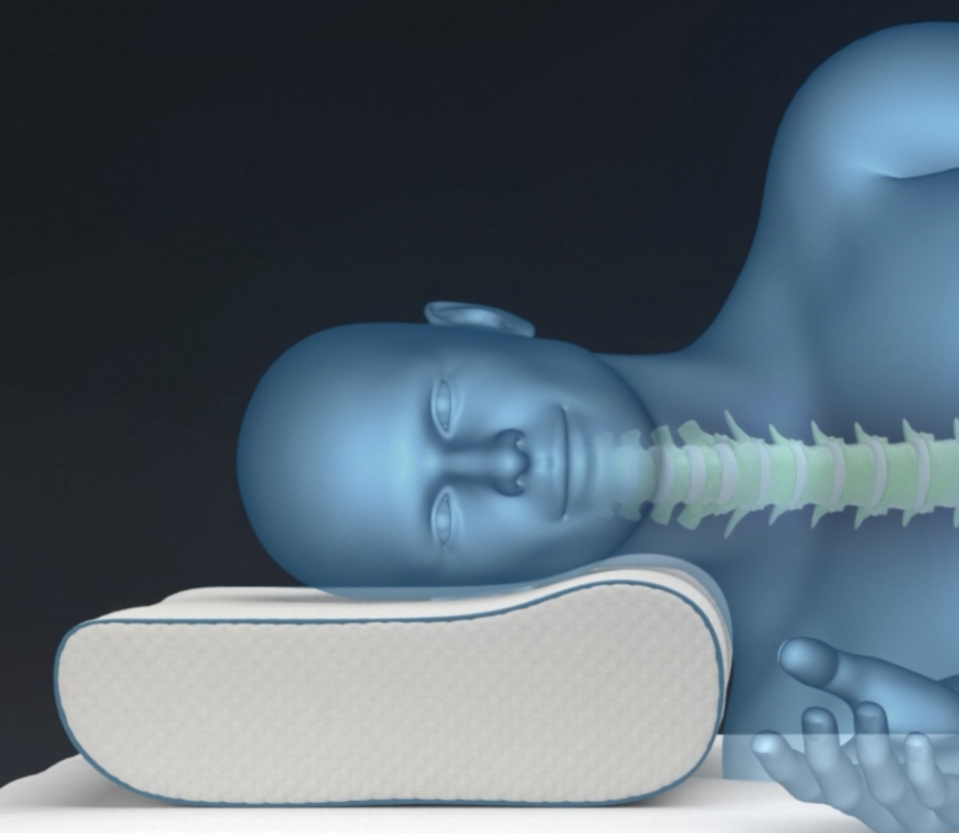
In a pilot EMG study of 15 adults lying on their side, pillow heights were set at 0.5, 1.0 and 1.5 times shoulder width. The height matching shoulder width produced the lowest sternocleidomastoid and trapezius activity and the highest comfort rating (Jiao et al., 2025).
Height also changes position and load. In 16 adults aged 20 to 30, pillows of 0, 10 and 20 cm changed T1 slope and the C2-7 Cobb angle on radiographs (Kim et al., 2015), and in 10 healthy participants lying on their backs, heights from 110 to 170 mm changed cranio-cervical pressure distribution and cervical alignment (Ren et al., 2016).
Why do generic pillows miss?
A standard contoured pillow, not fitted to the individual, performed no better than ordinary shapes in a randomized study of 106 side sleepers (Gordon et al., 2009). No single optimal pillow height can be specified, because it depends on four variables that differ from person to person: cervical alignment, body dimension, contact pressure, and muscle activity (Lei et al., 2021).
Read more: Why pillow fit matters more than shape
Related: Stress Awareness Month: How Sleep Supports Nervous System Recovery
What does a Pillowise fitting measure?
Pillowise is a fitted cervical pillow that licensed healthcare providers measure and dispense, made in seven sizes. Our sleep specialists take three measurements: shoulder width, neck circumference, and neck length. Combined with sleeping position and bed type, an algorithm identifies the best-fitting pillow from seven sizes.
Shoulder width is the measurement the EMG study found mattered most. A height matched to it produced the lowest neck and shoulder muscle activity during side sleeping (Jiao et al., 2025), and body dimension is what drives the individual optimum (Tian et al., 2025).
What does the research not show yet?
The pillow studies are small and were run in adults without neck pain: 15 in the EMG pilot, 16 in the radiographic study, and 9 in a side-lying modeling study, and none measured stress. Reviews of clinical outcomes are mixed; the most recent screened 29,091 records, included five studies covering 239 patients, and found no clear advantage for any pillow type in chronic neck pain (Ghosh et al., 2025). A fitted pillow is neck support for the night, used alongside the care a provider is already giving.
How can providers use this with stressed patients?
Ask three things: how stress is running, how many hours the patient sleeps, and whether the neck and shoulders feel worse on waking or later in the day. Ask which position they sleep in and what they sleep on.
Tell patients that stress, pain and poor sleep tend to appear together (Vinstrup et al., 2018), and that pillow height changes neck muscle activity in bed (Jiao et al., 2025). Stress management stays in the wider plan, and the pillow handles neck support at night.
A fitted pillow extends the work of the visit into the hours between visits, alongside the exercise, manual therapy, and other care you are already delivering.
Common questions
Is stress linked to neck and shoulder pain?
Stress and musculoskeletal pain were each associated with poor sleep in 3,593 hospital workers (Vinstrup et al., 2018). Office workers with neck pain showed higher sustained neck and shoulder muscle activity and less complete rest during keyboard work (Szeto et al., 2005). Both studies show association, not cause.
Does pillow height change neck muscle activity?
In a pilot study of 15 adults lying on their side, a height matched to shoulder width produced the lowest sternocleidomastoid and trapezius activity (Jiao et al., 2025). Body dimension drives the individual optimum height for side sleepers (Tian et al., 2025).
Is a contoured pillow from a store enough?
Not reliably. A standard contoured pillow, not fitted to the individual, performed no better than ordinary shapes in a randomized study of 106 side sleepers (Gordon et al., 2009), and no single optimal height can be specified because it depends on four variables that differ from person to person (Lei et al., 2021). A contour helps only if its height matches the person using it. That is what the fitting settles, in a provider's office.
Find a Pillowise provider or become one
Pillowise pillows are clinically measured and dispensed exclusively through licensed healthcare providers as part of broader sleep, posture, and recovery education.
To locate a Pillowise provider near you, visit: Find a Reseller
Licensed healthcare providers interested in offering Pillowise may register here: Become a Reseller
References
Chin, W.-S., Chen, Y.-C., Lin, T.-T., Guo, Y. L., & Shiao, J. S.-C. (2021). Short sleep and chronic neck and shoulder discomfort in nurses. Journal of Occupational Health, 63(1), e12236. https://doi.org/10.1002/1348-9585.12236
Ghosh, S. K., Goyal, M., & Goyal, K. S. (2025). Effect of pillow on pain, disability and sleep quality in patients with chronic neck pain: A systematic review. Rehabilitación, 59(3), 100922. https://doi.org/10.1016/j.rh.2025.100922
Gordon, S. J., Grimmer-Somers, K., & Trott, P. (2009). Pillow use: The behaviour of cervical pain, sleep quality and pillow comfort in side sleepers. Manual Therapy, 14(6), 671-678. https://doi.org/10.1016/j.math.2009.02.006
Jiao, R., Xiao, W., Wang, M., Yu, S., & Li, H. (2025). The impact of pillow height on neck muscle activity: A pilot study. Sleep and Breathing, 29(1), 40. https://doi.org/10.1007/s11325-024-03219-6
Kim, H. C., Jun, H. S., Kim, J. H., Ahn, J. H., Chang, I. B., Song, J. H., & Oh, J. K. (2015). The effect of different pillow heights on the parameters of cervicothoracic spine segments. Korean Journal of Spine, 12(3), 135-138. https://doi.org/10.14245/kjs.2015.12.3.135
Lei, J.-X., Yang, P.-F., Yang, A.-L., Gong, Y.-F., Shang, P., & Yuan, X.-C. (2021). Ergonomic consideration in pillow height determinants and evaluation. Healthcare, 9(10), 1333. https://doi.org/10.3390/healthcare9101333
McEwen, B. S., & Akil, H. (2020). Revisiting the stress concept: Implications for affective disorders. Journal of Neuroscience, 40(1), 12-21. https://doi.org/10.1523/JNEUROSCI.0733-19.2019
Ren, S., Wong, D. W.-C., Yang, H., Zhou, Y., Lin, J., & Zhang, M. (2016). Effect of pillow height on the biomechanics of the head-neck complex: Investigation of the cranio-cervical pressure and cervical spine alignment. PeerJ, 4, e2397. https://doi.org/10.7717/peerj.2397
Szeto, G. P., Straker, L. M., & O'Sullivan, P. B. (2005). A comparison of symptomatic and asymptomatic office workers performing monotonous keyboard work 1: Neck and shoulder muscle recruitment patterns. Manual Therapy, 10(4), 270-280. https://doi.org/10.1016/j.math.2005.01.004
Tian, S., Yao, C., Wang, Y., Cao, X., Sun, Y., Wang, L., & Fan, Y. (2025). The individualized optimal pillow height and neck support design for side sleepers. Medical and Biological Engineering and Computing, 63(2), 535-544. https://doi.org/10.1007/s11517-024-03204-x
Vinstrup, J., Jakobsen, M. D., Calatayud, J., Jay, K., & Andersen, L. L. (2018). Association of stress and musculoskeletal pain with poor sleep: Cross-sectional study among 3,600 hospital workers. Frontiers in Neurology, 9, 968. https://doi.org/10.3389/fneur.2018.00968
- Pillowise USA
- 615 W Johnson Ave, Suite 104
- Cheshire, CT 06410
- (844) 291 7392
- info@pillowise-usa.com
- Send us a message on WhatsApp