Spring Reset for Posture: Daytime Habits and Nighttime Neck Alignment
Last updated: October 2026
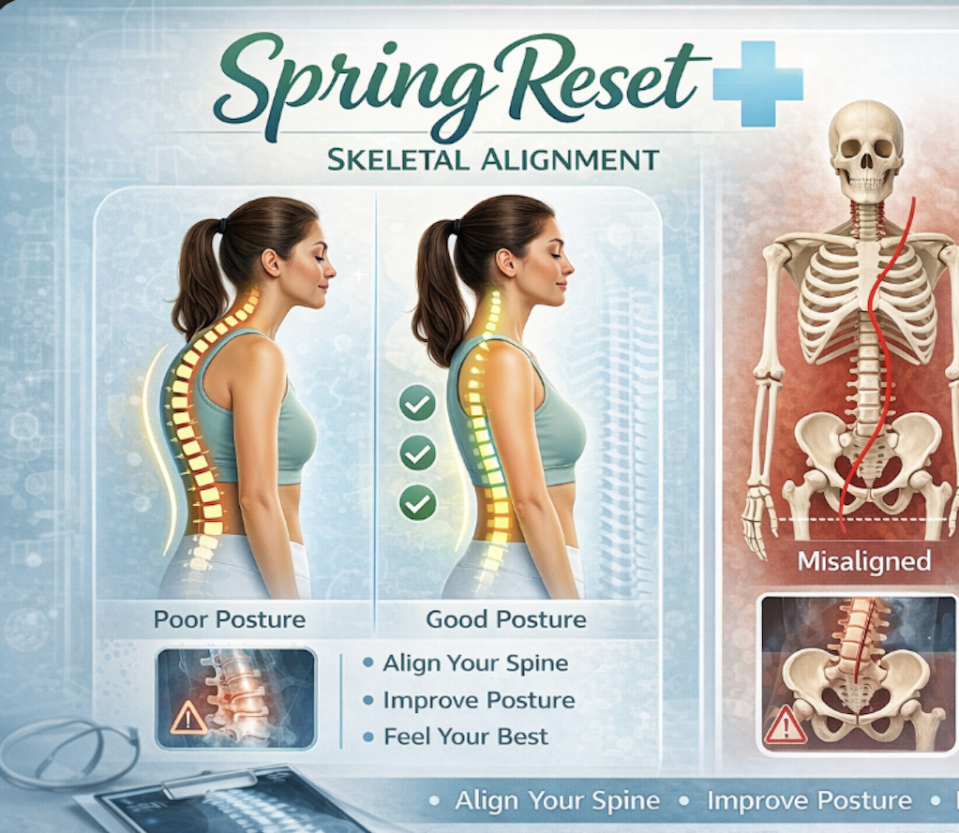
A spring reset for posture should cover the hours you sleep as well as the hours you sit, since head posture is associated with neck pain and pillow height measurably changes how the neck is aligned at night (Yip et al., 2008; Kim et al., 2015). Daytime habits and nighttime support address the same neck at different hours. The second half of this article covers what a Pillowise fitting measures and how your provider can fold sleep into a posture plan.
Key takeaways
- In a cross-sectional study of 62 people with neck pain and 52 without, the neck pain group had smaller craniovertebral angles, a measure of forward head posture (Yip et al., 2008).
- In radiographs of 16 adults, pillow height changed T1 slope, the C2-7 Cobb angle and neck tilt (Kim et al., 2015).
- Pillowise sleep specialists take three measurements (shoulder width, neck circumference, neck length) and combine them with sleeping position and bed type to identify the best-fitting pillow from seven sizes.
How does daytime posture relate to neck pain?
A cross-sectional study compared 62 people with neck pain and 52 without. The neck pain group had significantly smaller craniovertebral angles, a measure of forward head posture, and a smaller angle was associated with higher self-reported neck disability (Yip et al., 2008).
Desk work adds a muscle story. Office workers with neck pain showed different neck and shoulder muscle recruitment during keyboard work than workers without pain, including higher sustained activity and less complete muscle rest (Szeto et al., 2005).
A cross-sectional survey of office workers looked at individual and work-related risk factors for neck pain side by side (Cagnie et al., 2007). A posture reset looks at both as well: the person and the workstation.
What does a daytime posture reset include?
Set the screen at eye level, keep the feet flat and the shoulders relaxed, and bring the keyboard close enough that the elbows stay near the body. Stand up and move at regular intervals rather than holding one position through the morning.
Strength and mobility work prescribed by your chiropractor or physical therapist builds the capacity to hold that position. Each of these habits belongs to the waking day, and the night needs its own plan.
What happens to posture during sleep?
Sleep is a long, static posture, and the pillow sets the angle of the neck for all of it. In 16 adults without neck symptoms, raising pillow height from 0 to 10 to 20 cm increased T1 slope and the C2-7 Cobb angle while neck tilt decreased, and the authors judged 10 cm most suitable for normal cervical lordosis (Kim et al., 2015).
A crossover study with finite element modeling in 10 healthy participants lying on their backs showed that pillow height changes how pressure is distributed across the head and neck and how the cervical spine is aligned (Ren et al., 2016).
Muscle activity follows height too. In a pilot study of 15 adults sleeping on their side, a height matched to shoulder width produced the lowest sternocleidomastoid and trapezius activity and the highest comfort rating (Jiao et al., 2025).
Why do generic pillows miss?
A standard contoured pillow, not fitted to the individual, performed no better than ordinary shapes in a randomized study of 106 side sleepers (Gordon et al., 2009). No single optimal pillow height can be specified, because it depends on four variables that differ from person to person: cervical alignment, body dimension, contact pressure, and muscle activity (Lei et al., 2021).
Read more: Why pillow fit matters more than shape
Related: Office Ergonomics and Cervical Alignment for Desk Workers
What does a Pillowise fitting measure?
Pillowise is a fitted cervical pillow that licensed healthcare providers measure and dispense, made in seven sizes. Our sleep specialists take three measurements: shoulder width, neck circumference, and neck length. Combined with sleeping position and bed type, an algorithm identifies the best-fitting pillow from seven sizes.
Shoulder width is the measurement the EMG study found mattered most. A height matched to it produced the lowest neck and shoulder muscle activity during side sleeping (Jiao et al., 2025), and body dimension is what drives the individual optimum (Tian et al., 2025).
Pillowise pillows are made from premium Dutch memory foam, OEKO-TEX Standard 100 certified, with a uniform cervical height. The size is chosen from those three measurements plus sleeping position and bed type, rather than from a single stock height.
What does the research not show yet?
The posture studies show associations rather than cause and effect, and the pillow mechanism studies enrolled 9 to 16 people without neck pain (Yip et al., 2008; Kim et al., 2015; Jiao et al., 2025; Tian et al., 2025). Reviews of clinical outcomes are mixed, and the most recent screened 29,091 records, included five studies covering 239 patients, and found no clear advantage for any pillow type in chronic neck pain (Ghosh et al., 2025). We position a fitted pillow as an adjunct to the posture care your provider delivers.
How can providers fold sleep into a spring posture plan?
When a patient asks for a posture reset, ask about the night as well as the desk: preferred sleeping position, the age of the pillow, and whether the neck feels most stiff on waking or at the end of the workday. The answers show which part of the day needs the most attention.
Tell patients that the workstation changes and exercises cover the day, and the pillow covers the night. A fitted pillow extends the work of the visit into the hours between visits, alongside the exercise, manual therapy, and other care you are already delivering.
The fitting produces one size from seven. Returns and exchanges are handled by Pillowise directly.
Common questions
Is forward head posture linked to neck pain?
In a cross-sectional study of 62 people with neck pain and 52 without, the neck pain group had smaller craniovertebral angles (Yip et al., 2008). A smaller angle was associated with higher self-reported neck disability in the same study. Your chiropractor or physical therapist can measure your head posture and build a plan around it.
Why do my neck muscles feel tired after desk work?
Office workers with neck pain showed higher sustained neck and shoulder muscle activity and less complete muscle rest during keyboard work than workers without pain (Szeto et al., 2005). Regular movement breaks and a workstation set at eye level give those muscles a change of position through the day.
Does pillow height change neck alignment?
Pillow height changed T1 slope, the C2-7 Cobb angle, and neck tilt in radiographs of 16 adults (Kim et al., 2015). Height also changed cranio-cervical pressure and cervical alignment in a modeling study of 10 participants (Ren et al., 2016).
Is a contoured pillow from a store enough?
Not reliably. A standard contoured pillow, not fitted to the individual, performed no better than ordinary shapes in a randomized study of 106 side sleepers (Gordon et al., 2009), and no single optimal height can be specified because it depends on four variables that differ from person to person (Lei et al., 2021). A contour helps only if its height matches the person using it. That is what the fitting settles, in a provider's office.
Find a Pillowise provider or become one
Pillowise pillows are clinically measured and dispensed exclusively through licensed healthcare providers as part of broader sleep, posture, and recovery education.
To locate a Pillowise provider near you, visit: Find a Reseller
Licensed healthcare providers interested in offering Pillowise may register here: Become a Reseller
References
Cagnie, B., Danneels, L., Van Tiggelen, D., De Loose, V., & Cambier, D. (2007). Individual and work related risk factors for neck pain among office workers: A cross sectional study. European Spine Journal, 16(5), 679-686. https://doi.org/10.1007/s00586-006-0269-7
Ghosh, S. K., Goyal, M., & Goyal, K. S. (2025). Effect of pillow on pain, disability and sleep quality in patients with chronic neck pain: A systematic review. Rehabilitación, 59(3), 100922. https://doi.org/10.1016/j.rh.2025.100922
Gordon, S. J., Grimmer-Somers, K., & Trott, P. (2009). Pillow use: The behaviour of cervical pain, sleep quality and pillow comfort in side sleepers. Manual Therapy, 14(6), 671-678. https://doi.org/10.1016/j.math.2009.02.006
Jiao, R., Xiao, W., Wang, M., Yu, S., & Li, H. (2025). The impact of pillow height on neck muscle activity: A pilot study. Sleep and Breathing, 29(1), 40. https://doi.org/10.1007/s11325-024-03219-6
Kim, H. C., Jun, H. S., Kim, J. H., Ahn, J. H., Chang, I. B., Song, J. H., & Oh, J. K. (2015). The effect of different pillow heights on the parameters of cervicothoracic spine segments. Korean Journal of Spine, 12(3), 135-138. https://doi.org/10.14245/kjs.2015.12.3.135
Lei, J.-X., Yang, P.-F., Yang, A.-L., Gong, Y.-F., Shang, P., & Yuan, X.-C. (2021). Ergonomic consideration in pillow height determinants and evaluation. Healthcare, 9(10), 1333. https://doi.org/10.3390/healthcare9101333
Ren, S., Wong, D. W.-C., Yang, H., Zhou, Y., Lin, J., & Zhang, M. (2016). Effect of pillow height on the biomechanics of the head-neck complex: Investigation of the cranio-cervical pressure and cervical spine alignment. PeerJ, 4, e2397. https://doi.org/10.7717/peerj.2397
Szeto, G. P., Straker, L. M., & O'Sullivan, P. B. (2005). A comparison of symptomatic and asymptomatic office workers performing monotonous keyboard work 1: Neck and shoulder muscle recruitment patterns. Manual Therapy, 10(4), 270-280. https://doi.org/10.1016/j.math.2005.01.004
Tian, S., Yao, C., Wang, Y., Cao, X., Sun, Y., Wang, L., & Fan, Y. (2025). The individualized optimal pillow height and neck support design for side sleepers. Medical and Biological Engineering and Computing, 63(2), 535-544. https://doi.org/10.1007/s11517-024-03204-x
Yip, C. H. T., Chiu, T. T. W., & Poon, A. T. K. (2008). The relationship between head posture and severity and disability of patients with neck pain. Manual Therapy, 13 (2), 148-154. https://doi.org/10.1016/j.math.2006.11.002
- Pillowise USA
- 615 W Johnson Ave, Suite 104
- Cheshire, CT 06410
- (844) 291 7392
- info@pillowise-usa.com
- Send us a message on WhatsApp