
Sleep Strategies for Seasonal Allergy Relief
Last updated: October 2026
The sleep strategies with the best evidence for allergy season are intranasal corticosteroids, saline rinses, less alcohol before bed and simple bedroom allergen measures (Tabata et al., 2025; Head et al., 2018), plus a pillow that supports the neck in the positions congestion pushes you into. Seasonal allergies change how people sleep, not just how well they sleep. Lying down raises nasal airway resistance, so congestion that was manageable during the day becomes noticeable at bedtime (Calvo-Henríquez et al., 2022). Sleepers respond by rolling onto their side or stacking pillows, and those positions only hold through the night if the neck is supported in them.
Key takeaways
- Lying down raises nasal airway resistance: a meta-analysis of nine studies covering 291 participants found it significantly higher recumbent than upright (Calvo-Henríquez et al., 2022).
- Intranasal corticosteroids improved nocturnal quality of life scores in 18 randomized controlled trials covering 6,019 participants, though the effect sizes were small (Tabata et al., 2025).
- A Pillowise fitting uses shoulder width, neck circumference and neck length, plus sleeping position and bed type, to choose the best-fitting pillow from seven sizes.
How do seasonal allergies disrupt sleep?
A systematic review and meta-analysis of observational studies found allergic rhinitis associated with worse sleep quality, longer sleep latency, reduced sleep efficiency, and more daytime sleepiness (Liu et al., 2020). The authors rated the overall level of evidence as very low on the GRADE scale.
Lying down makes it worse. A systematic review and meta-analysis of nine studies covering 291 participants found nasal airway resistance significantly higher in the recumbent position than upright, with a larger change in people who snore or have sleep apnea (Calvo-Henríquez et al., 2022).
The downstream effects show up in population data. In the Wisconsin Sleep Cohort, people reporting nighttime rhinitis symptoms on five or more nights per month had significantly more habitual snoring, daytime sleepiness, and nonrestorative sleep, and those with allergy-related nasal congestion were 1.8 times more likely to have moderate to severe sleep-disordered breathing (Young et al., 1997). A systematic review of 11 polysomnographic studies found that nasal obstruction was not related to the apnea-hypopnea index (Migueis et al., 2016).
What helps allergy symptoms at night?
Intranasal corticosteroids have the strongest evidence. A systematic review and meta-analysis of 18 randomized controlled trials covering 6,019 participants found improvement in the sleep domain of the Rhinoconjunctivitis Quality of Life Questionnaire and in nocturnal quality of life scores (Tabata et al., 2025). The effect sizes were small, and daytime sleepiness on the Epworth Sleepiness Scale showed no significant change.
Timing and use are a conversation for the prescribing clinician.
Saline rinses may help, and they are cheap and safe. A Cochrane review of 14 studies covering 747 participants found saline irrigation may improve patient-reported disease severity for up to three months, with minimal adverse effects. The authors rated the evidence low to very low (Head et al., 2018).
Alcohol before bed changes sleep architecture. A meta-analysis of 27 studies in healthy adults found that even low doses, around two standard drinks, delayed the onset of REM sleep and reduced REM duration (Gardiner et al., 2025).
Bedroom allergen measures are low-cost habits. A scoping review of 18 studies found most reported reduced symptom severity or improved quality of life, while concluding a definitive recommendation is not possible given small samples (Tomé & Lourenço, 2023). A Cochrane review found impermeable bedding as an isolated intervention unlikely to offer benefit (Nurmatov et al., 2012).
Where does the pillow matter?
A cervical pillow does not affect the sinuses, drainage, or nasal airflow, and we make no claim that it does.
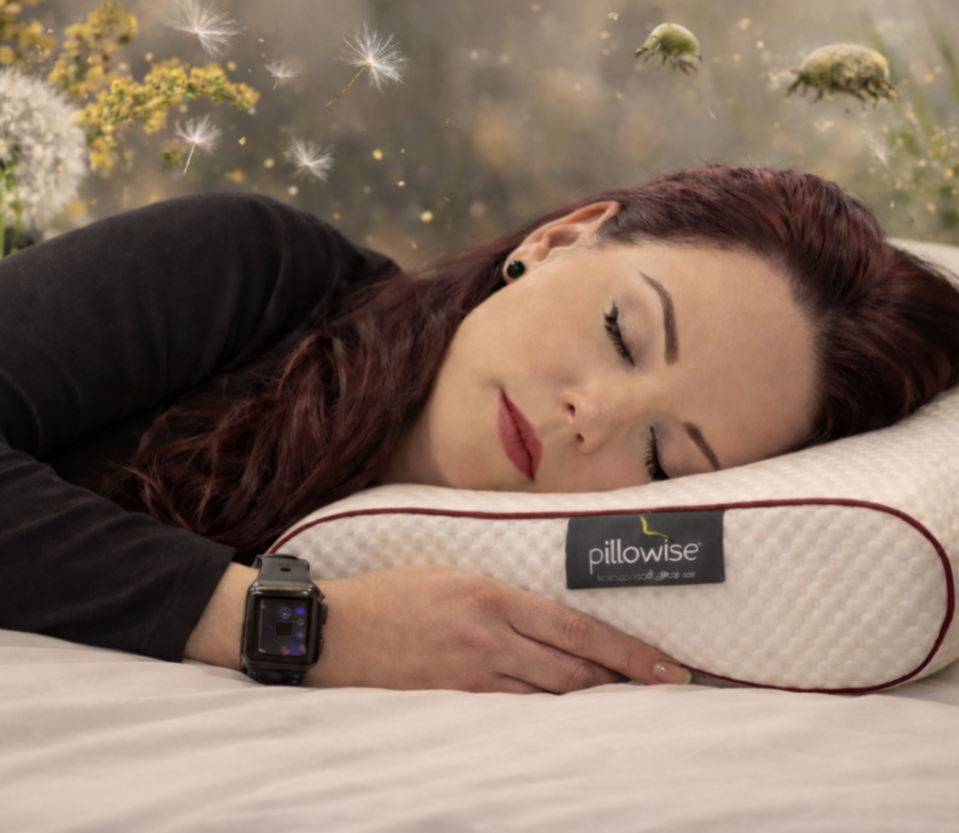
What changes during allergy season is sleep position. People move onto their side, prop themselves higher, or shift repeatedly through the night trying to get comfortable. A neck held at the wrong angle for six to eight hours adds a second problem on top of the first, and patients often arrive in spring reporting both congestion and morning neck pain without connecting them.
Pillow height measurably changes cervical alignment and how pressure is distributed across the head and neck (Kim et al., 2015; Ren et al., 2016). In a pilot study of 15 adults using surface EMG, a pillow height matched to shoulder width produced the lowest activity in the sternocleidomastoid and trapezius during side sleeping, and was rated most comfortable (Jiao et al., 2025). Side sleeping is where fit matters most, and side sleeping is where allergy season sends people.
A fitted pillow extends the work of the visit into the hours between visits, alongside the exercise, manual therapy, and other care the provider is already delivering.
Why do generic pillows miss?
A standard contoured pillow, not fitted to the individual, performed no better than ordinary shapes in a randomized study of 106 side sleepers (Gordon et al., 2009). No single optimal pillow height can be specified, because it depends on four variables that differ from person to person: cervical alignment, body dimension, contact pressure, and muscle activity (Lei et al., 2021).
Read more: Why pillow fit matters more than shape
Related: Sleep and Immune Function During Cold and Flu Season
What we measure
Pillowise is a fitted cervical pillow that licensed healthcare providers measure and dispense, made in seven sizes. Our sleep specialists take three measurements: shoulder width, neck circumference, and neck length. Combined with sleeping position and bed type, an algorithm identifies the best-fitting pillow from seven sizes.
Shoulder width is the measurement the EMG study found mattered most. A height matched to it produced the lowest neck and shoulder muscle activity during side sleeping (Jiao et al., 2025), and body dimension is what drives the individual optimum (Tian et al., 2025).
A systematic review of 11 studies covering 309 participants identified a 7 to 11 cm unloaded central height among the parameters supporting spinal alignment and sleep comfort (Radwan et al., 2021). During allergy season the value is specific: whatever position the patient settles into, the pillow height is matched to their measurements.
Scope
No trial has tested whether raising the head of the bed reduces congestion or assists sinus drainage; what is established is that nasal resistance is higher lying down than sitting up (Calvo-Henríquez et al., 2022). The pillow trials are small, and the most recent systematic review found no clear advantage for any pillow type in chronic neck pain (Ghosh et al., 2025). We position a fitted pillow as an adjunct to allergy management, not a substitute for it.
Common questions
Why are my allergies worse at night?
Lying down increases nasal airway resistance. A meta-analysis of nine studies found resistance significantly higher in the recumbent position than upright, with a larger change in people who snore or have sleep apnea (Calvo-Henríquez et al., 2022). Congestion that is tolerable standing up becomes more noticeable once you are horizontal, which is why symptoms often seem to arrive at bedtime rather than build through the day.
Does sleeping propped up help with congestion?
No trial has tested it, and what is established is only that lying flat raises nasal resistance compared with sitting up (Calvo-Henríquez et al., 2022). If sleeping more upright feels better, that is fine as a preference. Stacking pillows changes the neck angle too, which is a common reason spring brings both congestion and morning neck pain.
What should I sleep on during allergy season?
Allergy season pushes people onto their side, and side sleeping is where pillow height matters most. In a pilot EMG study, a height matched to the sleeper's shoulder width produced the lowest neck muscle activity during side sleeping and was rated most comfortable (Jiao et al., 2025). A standard contoured pillow, not fitted to the individual, performed no better than ordinary shapes in a randomized study of 106 side sleepers (Gordon et al., 2009), so the variable that matters is height matched to the person.
Is a contoured pillow from a store enough?
Not reliably. A standard contoured pillow, not fitted to the individual, performed no better than ordinary shapes in a randomized study of 106 side sleepers (Gordon et al., 2009), and no single optimal height can be specified because it depends on four variables that differ from person to person (Lei et al., 2021). A contour helps only if its height matches the person using it. That is what the fitting settles, in a provider's office.
Find a Pillowise provider or become one
Pillowise pillows are clinically measured and dispensed exclusively through licensed healthcare providers as part of broader sleep, posture, and recovery education.
To locate a Pillowise provider near you, visit: Find a Reseller
Licensed healthcare providers interested in offering Pillowise may register here: Become a Reseller
References
Calvo-Henríquez, C., Chiesa-Estomba, C., Lechien, J. R., Carrasco-Llatas, M., Cammaroto, G., Mayo-Yáñez, M., Abelleira-Paris, R., Gonzalez-Barcala, F. J., Martinez-Capoccioni, G., & Martin-Martin, C. (2022). The recumbent position affects nasal resistance: A systematic review and meta-analysis. The Laryngoscope, 132(1), 6-16. https://doi.org/10.1002/lary.29509
Gardiner, C., Weakley, J., Burke, L. M., Roach, G. D., Sargent, C., Maniar, N., Huynh, M., Miller, D. J., Townshend, A., & Halson, S. L. (2025). The effect of alcohol on subsequent sleep in healthy adults: A systematic review and meta-analysis. Sleep Medicine Reviews, 80, 102030. https://doi.org/10.1016/j.smrv.2024.102030
Ghosh, S. K., Goyal, M., & Goyal, K. S. (2025). Effect of pillow on pain, disability and sleep quality in patients with chronic neck pain: A systematic review. Rehabilitación, 59(3), 100922. https://doi.org/10.1016/j.rh.2025.100922
Gordon, S. J., Grimmer-Somers, K., & Trott, P. (2009). Pillow use: The behaviour of cervical pain, sleep quality and pillow comfort in side sleepers. Manual Therapy, 14(6), 671-678. https://doi.org/10.1016/j.math.2009.02.006
Head, K., Snidvongs, K., Glew, S., Scadding, G., Schilder, A. G. M., Philpott, C., & Hopkins, C. (2018). Saline irrigation for allergic rhinitis. Cochrane Database of Systematic Reviews, 2018(6), CD012597. https://doi.org/10.1002/14651858.CD012597.pub2
Jiao, R., Xiao, W., Wang, M., Yu, S., & Li, H. (2025). The impact of pillow height on neck muscle activity: A pilot study. Sleep and Breathing, 29(1), 40. https://doi.org/10.1007/s11325-024-03219-6
Kim, H. C., Jun, H. S., Kim, J. H., Ahn, J. H., Chang, I. B., Song, J. H., & Oh, J. K. (2015). The effect of different pillow heights on the parameters of cervicothoracic spine segments. Korean Journal of Spine, 12(3), 135-138. https://doi.org/10.14245/kjs.2015.12.3.135
Lei, J.-X., Yang, P.-F., Yang, A.-L., Gong, Y.-F., Shang, P., & Yuan, X.-C. (2021). Ergonomic consideration in pillow height determinants and evaluation. Healthcare, 9(10), 1333. https://doi.org/10.3390/healthcare9101333
Liu, J., Zhang, X., Zhao, Y., & Wang, Y. (2020). The association between allergic rhinitis and sleep: A systematic review and meta-analysis of observational studies. PLOS ONE, 15(2), e0228533. https://doi.org/10.1371/journal.pone.0228533
Migueis, D. P., Thuler, L. C. S., Lemes, L. N. A., Moreira, C. S. S., Joffily, L., & Araújo-Melo, M. H. (2016). Systematic review: The influence of nasal obstruction on sleep apnea. Brazilian Journal of Otorhinolaryngology, 82(2), 223-231. https://doi.org/10.1016/j.bjorl.2015.05.018
Nurmatov, U., van Schayck, C. P., Hurwitz, B., & Sheikh, A. (2012). House dust mite avoidance measures for perennial allergic rhinitis: An updated Cochrane systematic review. Allergy, 67(2), 158-165. https://doi.org/10.1111/j.1398-9995.2011.02752.x
Radwan, A., Ashton, N., Gates, T., Kilmer, A., & VanFleet, M. (2021). Effect of different pillow designs on promoting sleep comfort, quality, & spinal alignment: A systematic review. European Journal of Integrative Medicine, 42, 101269. https://doi.org/10.1016/j.eujim.2020.101269
Ren, S., Wong, D. W.-C., Yang, H., Zhou, Y., Lin, J., & Zhang, M. (2016). Effect of pillow height on the biomechanics of the head-neck complex: Investigation of the cranio-cervical pressure and cervical spine alignment. PeerJ, 4, e2397. https://doi.org/10.7717/peerj.2397
Tabata, K., Sumi, Y., Sasaki, H., & Kojimahara, N. (2025). Effectiveness of intranasal corticosteroids for sleep disturbances in patients with allergic rhinitis: A systematic review and meta-analysis. International Archives of Allergy and Immunology, 186(4), 330-344. https://doi.org/10.1159/000541389
Tian, S., Yao, C., Wang, Y., Cao, X., Sun, Y., Wang, L., & Fan, Y. (2025). The individualized optimal pillow height and neck support design for side sleepers. Medical and Biological Engineering and Computing, 63(2), 535-544. https://doi.org/10.1007/s11517-024-03204-x
Tomé, M., & Lourenço, O. (2023). Avoidance measures for patients with allergic rhinitis: A scoping review. Children, 10(2), 300. https://doi.org/10.3390/children10020300
Young, T., Finn, L., & Kim, H. (1997). Nasal obstruction as a risk factor for sleep-disordered breathing. Journal of Allergy and Clinical Immunology, 99(2), S757-S762. https://doi.org/10.1016/S0091-6749(97)70124-6
- Pillowise USA
- 615 W Johnson Ave, Suite 104
- Cheshire, CT 06410
- (844) 291 7392
- info@pillowise-usa.com
- Send us a message on WhatsApp