

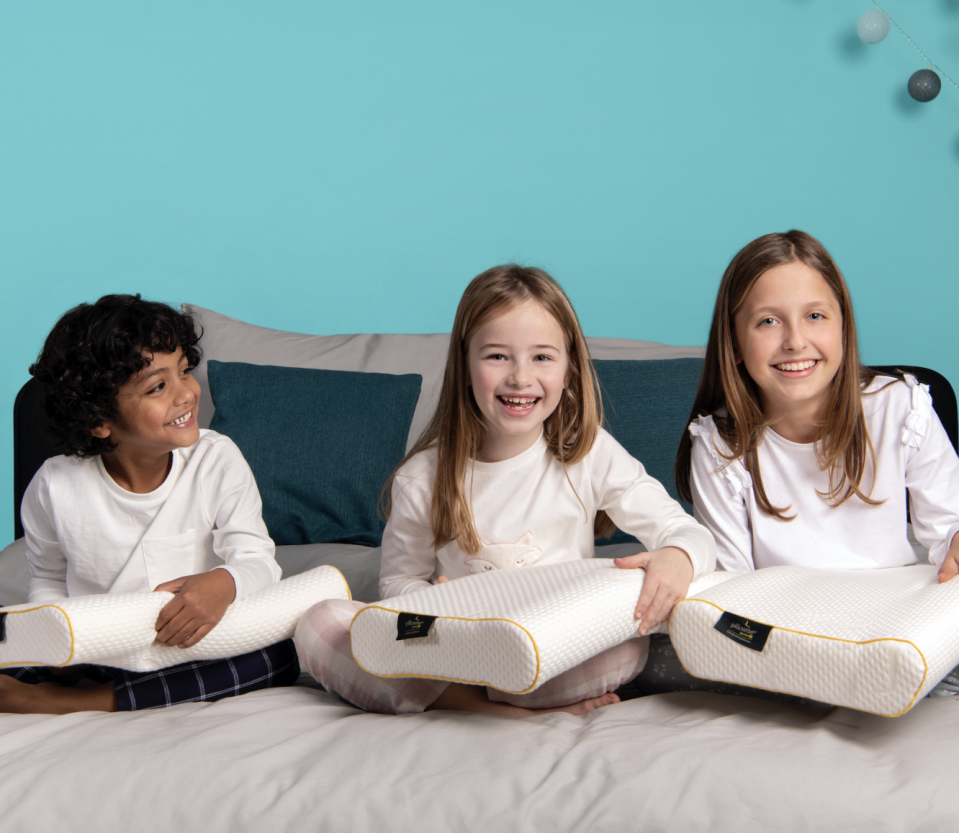
Pillowise Junior: Fitted Cervical Pillows for Children in Three Sizes
Last updated: October 2026
Pillowise Junior is the children's line of Pillowise pillows, made in sizes 1, 2 and 3 and fitted by a licensed healthcare provider, and it rests on a principle measured in adults: pillow height changes the angles of the neck during sleep (Kim et al., 2015). A child's shoulders and neck are smaller than an adult's, which is the practical reason a separate Junior line exists. This article covers what pillow height changes, why one height cannot suit everyone, and how a provider chooses a Junior size for your child.
Key takeaways
- Pillowise Junior is the children's line of Pillowise pillows, made in sizes 1, 2 and 3 and fitted by a licensed healthcare provider.
- In a pilot study of 15 adults using surface EMG, the pillow height matching shoulder width produced the lowest neck and shoulder muscle activity during side sleeping (Jiao et al., 2025).
- For adults, Pillowise sleep specialists take three measurements, shoulder width, neck circumference and neck length, and with sleeping position and bed type an algorithm identifies the best fit from seven sizes.
Why does pillow size matter for a child?
Many children sleep on whatever pillow the household already owns, often one bought with an adult in mind. Store pillows come in a handful of heights, and the choice is rarely made with the child's size in view.
Pillow choice matters in measurable ways. In a randomized study of 106 adult side sleepers, pillow type changed waking cervical pain and sleep quality (Gordon et al., 2009).
The adult literature gives a range, not a single number. A systematic review of 11 studies covering 309 participants identified a 7 to 11 cm unloaded central height among the parameters supporting spinal alignment and sleep comfort (Radwan et al., 2021).
What does pillow height change?
Sleep is the longest static posture of the day. Whatever position the pillow sets, the neck holds for hours, without the movement that shifts load around while awake.
A radiographic study of 16 adults aged 20 to 30 measured the neck at pillow heights of 0, 10 and 20 cm. As height increased, T1 slope and C2-7 Cobb angle increased while neck tilt decreased (Kim et al., 2015).
A crossover study of 10 healthy young adults lying on their backs combined participant testing with finite element modeling across heights of 110 to 170 mm. It quantified how pillow height shifts pressure across the head and changes cervical alignment (Ren et al., 2016).
In a pilot study of 15 adults aged 18 to 30 using surface EMG, pillow heights were set relative to each person's shoulder width. The height matching shoulder width produced the lowest sternocleidomastoid and trapezius activity during side sleeping and the highest comfort rating (Jiao et al., 2025).
Why do generic pillows miss?
A standard contoured pillow, not fitted to the individual, performed no better than ordinary shapes in a randomized study of 106 side sleepers (Gordon et al., 2009). No single optimal pillow height can be specified, because it depends on four variables that differ from person to person: cervical alignment, body dimension, contact pressure, and muscle activity (Lei et al., 2021).
Read more: Why pillow fit matters more than shape
Related: School-Night Sleep Routines for Kids and How to Choose the Right Pillow
What do we measure?
Pillowise makes fitted cervical pillows that licensed healthcare providers measure and dispense, including Pillowise Junior for children in sizes 1, 2 and 3. The standard Pillowise fitting describes our adult range. Our sleep specialists take three measurements: shoulder width, neck circumference, and neck length. Combined with sleeping position and bed type, an algorithm identifies the best-fitting pillow from seven sizes.
The research behind that fitting was carried out in adults. Shoulder width is the measurement the EMG study found mattered most. A height matched to it produced the lowest neck and shoulder muscle activity during side sleeping (Jiao et al., 2025), and body dimension is what drives the individual optimum (Tian et al., 2025).
How is a Pillowise Junior size chosen?
Pillowise Junior is a separate line made for children, listed under Junior on our website in sizes 1, 2 and 3. A licensed healthcare provider fits your child to one of those three Junior sizes.
The principle is the same one that runs through the adult research: the pillow is matched to the person rather than sold in one height. The result is a Junior size chosen for your child, not a height picked off a shelf.
The fitting happens in the provider's office, so the parent can ask questions on the spot. Returns and exchanges are handled by Pillowise directly.
What does the research not show yet?
Every study cited here enrolled adults, the mechanism studies included 9 to 16 healthy adults each, and the most recent systematic review screened 29,091 records, included five studies covering 239 patients, and found no clear advantage for any pillow type in chronic neck pain (Ghosh et al., 2025). Pillowise Junior is a comfort and fit product sized for children, used alongside the care your child's pediatrician and other providers already give.
What helps a child settle with a new pillow?
Keep the rest of the bedtime routine the same, so the pillow is the only thing that changes. Let your child try the new pillow for several nights before judging it, since a different height can feel unfamiliar at first.
Watch how your child sleeps rather than asking only how it feels. A head that stays level with the spine when lying on the side is the landmark the provider is aiming for.
For providers
Ask parents what pillow the child uses now, where it came from, and whether the child sleeps mostly on the side, back or stomach. It is a short question about a large share of the child's day.
Tell parents what the fitting does: it places the child in one of three Junior sizes, and the same measure-first principle applies to the adults in the household. Give them the side-lying landmark to check at home.
A fitted pillow extends the work of the visit into the hours between visits, alongside the exercise, manual therapy, and other care the provider is already delivering.
Common questions
What sizes does Pillowise Junior come in?
Pillowise Junior comes in sizes 1, 2 and 3, listed under Junior on our website. A licensed healthcare provider fits the child to one of the three. The aim is the one the adult research supports: height matched to the person, with the shoulder-width-matched height producing the lowest neck muscle activity in a pilot study of 15 adults (Jiao et al., 2025).
Can my child use an adult Pillowise pillow?
The adult fitting chooses from seven sizes using measurements taken on an adult body. Body dimension drives the individual optimum in adult side sleepers (Tian et al., 2025), and a child's body dimensions are smaller. Ask your provider which line fits your child.
Is a contoured pillow from a store enough?
Not reliably. A standard contoured pillow, not fitted to the individual, performed no better than ordinary shapes in a randomized study of 106 side sleepers (Gordon et al., 2009), and no single optimal height can be specified because it depends on four variables that differ from person to person (Lei et al., 2021). A contour helps only if its height matches the person using it. That is what the fitting settles, in a provider's office.
Find a Pillowise provider or become one
Pillowise pillows are clinically measured and dispensed exclusively through licensed healthcare providers as part of broader sleep, posture, and recovery education.
To locate a Pillowise provider near you, visit: Find a Reseller
Licensed healthcare providers interested in offering Pillowise may register here: Become a Reseller
References
Ghosh, S. K., Goyal, M., & Goyal, K. S. (2025). Effect of pillow on pain, disability and sleep quality in patients with chronic neck pain: A systematic review. Rehabilitación, 59(3), 100922. https://doi.org/10.1016/j.rh.2025.100922
Gordon, S. J., Grimmer-Somers, K., & Trott, P. (2009). Pillow use: The behaviour of cervical pain, sleep quality and pillow comfort in side sleepers. Manual Therapy, 14(6), 671-678. https://doi.org/10.1016/j.math.2009.02.006
Jiao, R., Xiao, W., Wang, M., Yu, S., & Li, H. (2025). The impact of pillow height on neck muscle activity: A pilot study. Sleep and Breathing, 29(1), 40. https://doi.org/10.1007/s11325-024-03219-6
Kim, H. C., Jun, H. S., Kim, J. H., Ahn, J. H., Chang, I. B., Song, J. H., & Oh, J. K. (2015). The effect of different pillow heights on the parameters of cervicothoracic spine segments. Korean Journal of Spine, 12(3), 135-138. https://doi.org/10.14245/kjs.2015.12.3.135
Lei, J.-X., Yang, P.-F., Yang, A.-L., Gong, Y.-F., Shang, P., & Yuan, X.-C. (2021). Ergonomic consideration in pillow height determinants and evaluation. Healthcare, 9(10), 1333. https://doi.org/10.3390/healthcare9101333
Radwan, A., Ashton, N., Gates, T., Kilmer, A., & VanFleet, M. (2021). Effect of different pillow designs on promoting sleep comfort, quality, & spinal alignment: A systematic review. European Journal of Integrative Medicine, 42, 101269. https://doi.org/10.1016/j.eujim.2020.101269
Ren, S., Wong, D. W.-C., Yang, H., Zhou, Y., Lin, J., & Zhang, M. (2016). Effect of pillow height on the biomechanics of the head-neck complex: Investigation of the cranio-cervical pressure and cervical spine alignment. PeerJ, 4, e2397. https://doi.org/10.7717/peerj.2397
Tian, S., Yao, C., Wang, Y., Cao, X., Sun, Y., Wang, L., & Fan, Y. (2025). The individualized optimal pillow height and neck support design for side sleepers. Medical and Biological Engineering and Computing, 63(2), 535-544. https://doi.org/10.1007/s11517-024-03204-x

- Pillowise USA
- 615 W Johnson Ave, Suite 104
- Cheshire, CT 06410
- (844) 291 7392
- info@pillowise-usa.com
- Send us a message on WhatsApp