

Adjusting Pillow Height for Neck Pain: What the Clinical Studies Found
Last updated: October 2026
Adjusting pillow height has been studied in people with neck pain, and the results lean positive but are modest: in an uncontrolled study of 84 adults with stiff shoulders and neck pain, half of participants reached a clinically meaningful improvement after their pillow height was adjusted (Yamada et al., 2023). A randomized trial found a designed pillow reduced neck pain more than ergonomic education alone (Vanti et al., 2019). Below is what each study tested, what the pooled evidence shows, and why measured height is the variable that keeps coming up.
Key takeaways
- In an uncontrolled study of 84 adults with neck pain, half reached a clinically meaningful improvement after pillow height was adjusted (Yamada et al., 2023).
- In a randomized crossover trial of 64 completers, a designed pillow reduced neck pain more than ergonomic education alone (Vanti et al., 2019).
- A Pillowise fitting takes three measurements (shoulder width, neck circumference and neck length) and adds sleeping position and bed type to choose from seven sizes.
What happens when pillow height is adjusted?
A prospective before-and-after study followed 84 participants with stiff shoulders and neck pain whose pillow height was adjusted. Forty-two of them, 50 percent, reached the minimal clinically important difference for neck pain, a drop of 3 or more points on a 0 to 10 scale (Yamada et al., 2023).
The study had no control group and was not randomized, so it shows what happened to participants rather than what the adjustment caused.
What did a randomized trial find?
A randomized crossover trial enrolled 70 adults with chronic nonspecific neck pain lasting 3 months or longer, and 64 completed it. Each participant spent 4 weeks with a designed spring pillow and 4 weeks with ergonomic education alone (Vanti et al., 2019).
The pillow period produced greater reductions in neck pain (a mean difference of 8.7 points on a 0 to 100 scale), thoracic pain (8.4 points), and headache (16.0 points). The trial tested one specific pillow design against advice, not a fitted pillow.
What do the pooled studies show?
A systematic review and meta-analysis reviewed 35 articles and pooled 9 studies covering 555 participants. Pillow use improved waking pain and neck disability, with satisfaction increasing (Pang et al., 2021).
An older comparative study gave 55 participants six pillows over three weeks. Thirty-six of 55 reported a positive effect on sleep, 27 of 42 reported pain reduction, and a pillow with firmer cores supporting the cervical lordosis was rated highest (Persson & Moritz, 1998).
Why does height matter at all?
Pillow height changes the neck in ways that can be measured. In a radiographic study of 16 adults, T1 slope and C2-7 Cobb angle increased as height rose from 0 to 10 to 20 cm, while neck tilt decreased (Kim et al., 2015).
In a pilot EMG study of 15 adults lying on their side, the height matched to shoulder width produced the lowest neck and shoulder muscle activity (Jiao et al., 2025). Among 9 healthy side sleepers, body dimension drove each person's optimal height (Tian et al., 2025).
Why do generic pillows miss?
A standard contoured pillow, not fitted to the individual, performed no better than ordinary shapes in a randomized study of 106 side sleepers (Gordon et al., 2009). No single optimal pillow height can be specified, because it depends on four variables that differ from person to person: cervical alignment, body dimension, contact pressure, and muscle activity (Lei et al., 2021).
Read more: Why pillow fit matters more than shape
Related: How Do You Know If Your Pillow Is the Wrong Height?
What we measure
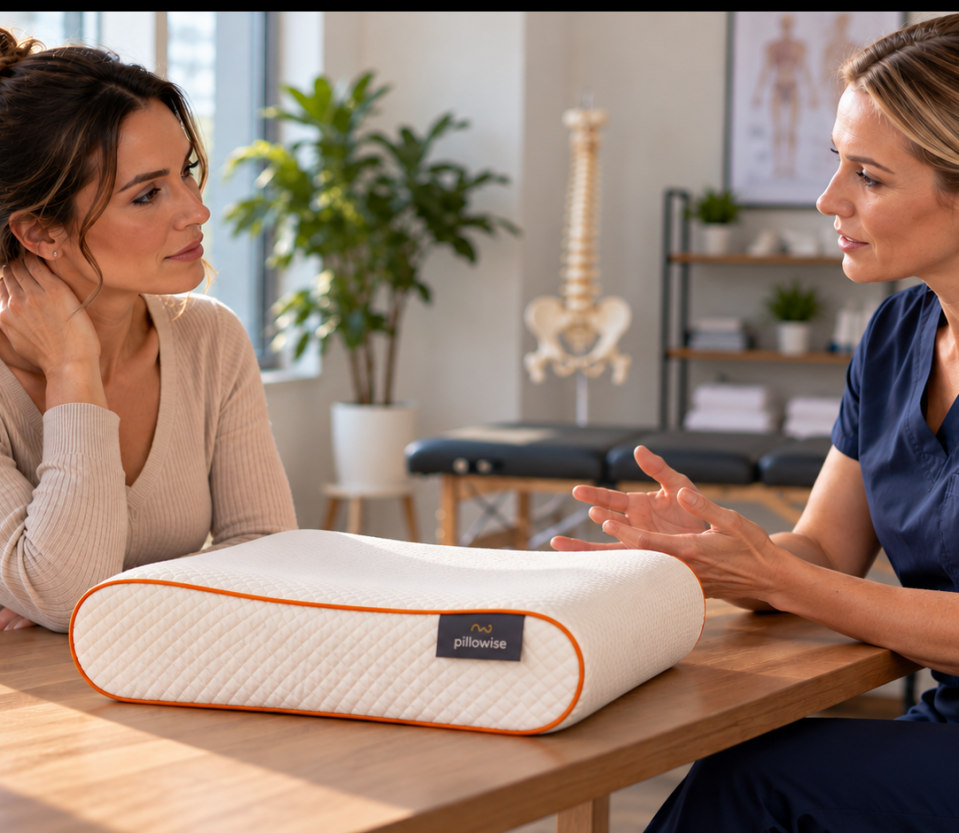
Pillowise is a fitted cervical pillow that licensed healthcare providers measure and dispense, made in seven sizes.
Our sleep specialists take three measurements: shoulder width, neck circumference, and neck length. Combined with sleeping position and bed type, an algorithm identifies the best-fitting pillow from seven sizes.
Shoulder width is the measurement the EMG study found mattered most. A height matched to it produced the lowest neck and shoulder muscle activity during side sleeping (Jiao et al., 2025), and body dimension is what drives the individual optimum (Tian et al., 2025).
A systematic review of 11 studies covering 309 participants identified a 7 to 11 cm unloaded central height among the parameters supporting spinal alignment and sleep comfort (Radwan et al., 2021). The size is chosen from those three measurements plus sleeping position and bed type, rather than from a single stock height.
Pillowise pillows are made from premium Dutch memory foam and certified to OEKO-TEX Standard 100, meaning every component has been tested against the standard's limits for harmful substances.
Scope
None of these studies tested a Pillowise pillow, and no published study has. The most recent systematic review screened 29,091 records, included five studies covering 239 patients, and found no clear advantage for any pillow type in chronic neck pain (Ghosh et al., 2025). We position a fitted pillow as an adjunct to care, not a treatment for neck pain.
For providers
When a patient with neck pain asks about pillows, the studies above give you something specific to say: height has been adjusted with measurable results in some patients, and the size of the effect varies.
Ask how old the current pillow is, how the patient sleeps, and whether they wake stiff. Those answers decide whether pillow height belongs in the plan.
A fitted pillow extends the work of the visit into the hours between visits, alongside the exercise, manual therapy, and other care the provider is already delivering.
Common questions
Can changing my pillow help neck pain?
For some people in the studies, yes. In an uncontrolled study, half of 84 participants reached a clinically meaningful improvement after pillow height was adjusted (Yamada et al., 2023), and a meta-analysis of 555 participants found pillow use improved waking pain and neck disability (Pang et al., 2021).
How long did the pillow studies run?
Most ran for weeks, not months. The randomized trial gave each participant 4 weeks per arm (Vanti et al., 2019), and the comparative study ran three weeks (Persson & Moritz, 1998).
Did these studies test Pillowise?
No. The randomized trial tested a specific spring pillow (Vanti et al., 2019), and no published study has tested a Pillowise pillow. What the research supports is matching height to the person, which is what the fitting does.
Is a contoured pillow from a store enough?
Not reliably. A standard contoured pillow, not fitted to the individual, performed no better than ordinary shapes in a randomized study of 106 side sleepers (Gordon et al., 2009), and no single optimal height can be specified because it depends on four variables that differ from person to person (Lei et al., 2021). A contour helps only if its height matches the person using it. That is what the fitting settles, in a provider's office.
Find a Pillowise provider or become one
Pillowise pillows are clinically measured and dispensed exclusively through licensed healthcare providers as part of broader sleep, posture, and recovery education.
To locate a Pillowise provider near you, visit: Find a Reseller
Licensed healthcare providers interested in offering Pillowise may register here: Become a Reseller
References
Ghosh, S. K., Goyal, M., & Goyal, K. S. (2025). Effect of pillow on pain, disability and sleep quality in patients with chronic neck pain: A systematic review. Rehabilitación, 59(3), 100922. https://doi.org/10.1016/j.rh.2025.100922
Gordon, S. J., Grimmer-Somers, K., & Trott, P. (2009). Pillow use: The behavior of cervical pain, sleep quality and pillow comfort in side sleepers. Manual Therapy, 14 (6), 671-678. https://doi.org/10.1016/j.math.2009.02.006
Jiao, R., Xiao, W., Wang, M., Yu, S., & Li, H. (2025). The impact of pillow height on neck muscle activity: A pilot study. Sleep and Breathing, 29 (1), 40. https://doi.org/10.1007/s11325-024-03219-6
Kim, H. C., Jun, H. S., Kim, J. H., Ahn, J. H., Chang, I. B., Song, J. H., & Oh, J. K. (2015). The effect of different pillow heights on the parameters of cervicothoracic spine segments. Korean Journal of Spine, 12 (3), 135-138. https://doi.org/10.14245/kjs.2015.12.3.135
Lei, J.-X., Yang, P.-F., Yang, A.-L., Gong, Y.-F., Shang, P., & Yuan, X.-C. (2021). Ergonomic consideration in pillow height determinants and evaluation. Healthcare, 9 (10), 1333. https://doi.org/10.3390/healthcare9101333
Pang, JC-Y., Tsang, SM-H., & Fu, AC-L. (2021). The effects of pillow designs on neck pain, waking symptoms, neck disability, sleep quality and spinal alignment in adults: A systematic review and meta-analysis. Clinical Biomechanics, 85 , 105353. https://doi.org/10.1016/j.clinbiomech.2021.105353
Persson, L., & Moritz, U. (1998). Neck support pillows: A comparative study. Journal of Manipulative and Physiological Therapeutics, 21 (4), 237-240. https://pubmed.ncbi.nlm.nih.gov/9608378/
Radwan, A., Ashton, N., Gates, T., Kilmer, A., & VanFleet, M. (2021). Effect of different pillow designs on promoting sleep comfort, quality, & spinal alignment: A systematic review. European Journal of Integrative Medicine, 42 , 101269. https://doi.org/10.1016/j.eujim.2020.101269
Tian, S., Yao, C., Wang, Y., Cao, X., Sun, Y., Wang, L., & Fan, Y. (2025). The individualized optimal pillow height and neck support design for side sleepers. Medical and Biological Engineering and Computing, 63 (2), 535-544. https://doi.org/10.1007/s11517-024-03204-x
Vanti, C., Banchelli, F., Marino, C., Puccetti, A., Guccione, A. A., & Pillastrini, P. (2019). Effectiveness of a "spring pillow" versus education in chronic nonspecific neck pain: A randomized controlled trial. Physical Therapy, 99 (9), 1177-1188. https://doi.org/10.1093/ptj/pzz056
Yamada, S., Hoshi, T., Toda, M., Tsuge, T., Matsudaira, K., & Oka, H. (2023). Changes in neck pain and somatic symptoms before and after the adjustment of the pillow height. Journal of Physical Therapy Science, 35 (2), 106-113. https://doi.org/10.1589/jpts.35.106

- Pillowise USA
- 615 W Johnson Ave, Suite 104
- Cheshire, CT 06410
- (844) 291 7392
- info@pillowise-usa.com
- Send us a message on WhatsApp